An AI content calendar is useful when it turns a specific idea into a draft you can work with. In Google Sheets, the GPT for Sheets and Docs extension can generate a hook, an outline or a suggested format from the information in another cell. You keep the calendar, the brief and the editorial decisions together.
Here’s how to use the calendar template, then build a small example you can adapt for social posts, videos or blog articles.
Start with the content calendar template
Open the content calendar template, then choose File > Make a copy to save an editable version in your own Google Drive.
The template has an index and monthly tabs, with space for dates, ideas, hooks, outlines, hashtags, platforms and production status. Its original calendar is for 2024: update the dates, weekdays and seasonal events for the year you are planning. The screenshot below shows that original version.
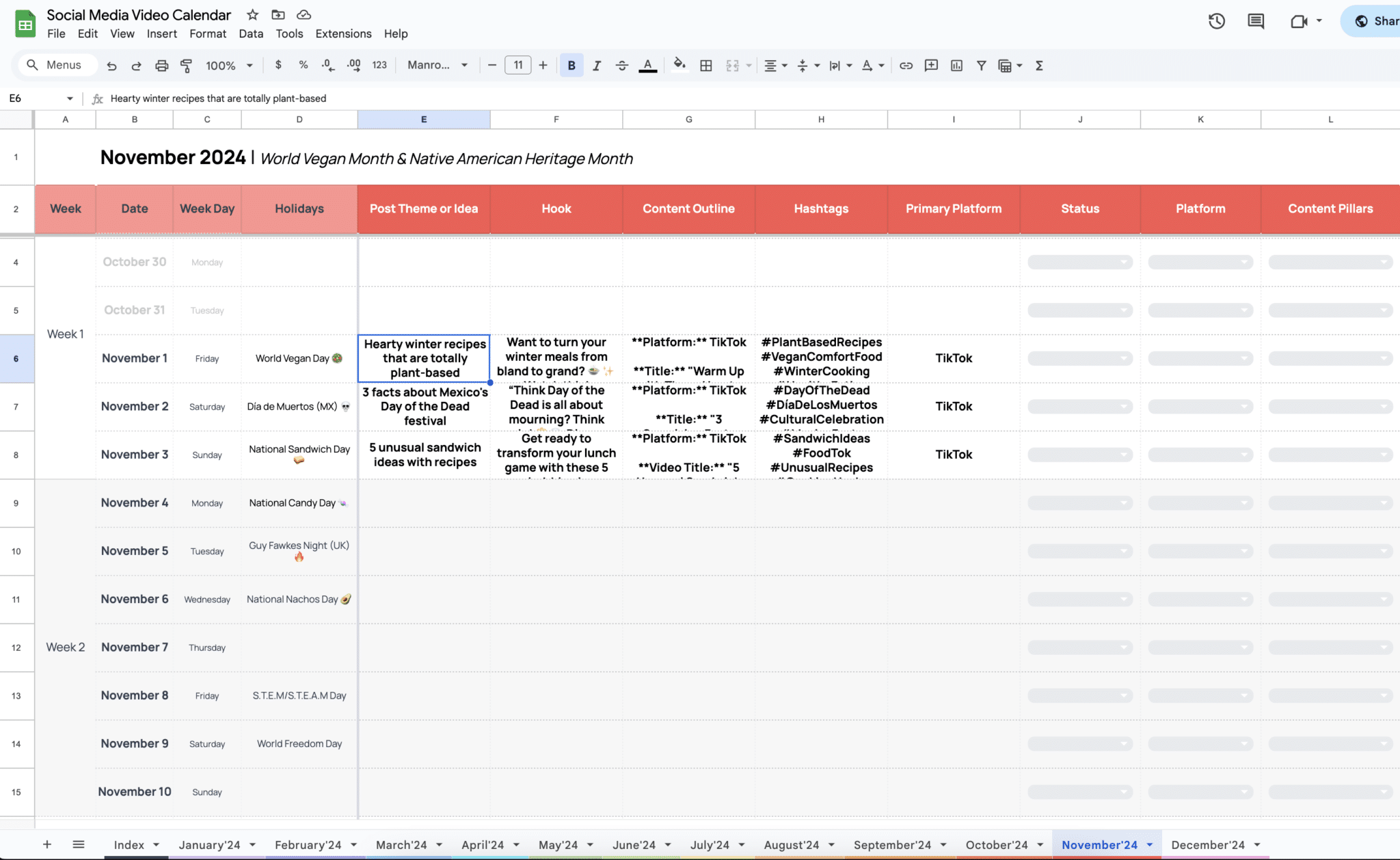
Start with a few ideas that answer real audience questions. A date in the calendar is a place to organise an idea, not a reason to publish one.
Set up GPT for Sheets
- Install GPT for Sheets and Docs from the Google Workspace Marketplace.
- In your copied spreadsheet, select Extensions > GPT for Sheets and Docs > Open. Complete the add-on’s setup and choose a model in its sidebar.
- Check the add-on’s credits and usage settings before running a batch. AI requests consume usage credits; copying the calendar itself does not include those credits.
- Try one formula in an empty cell before filling a column.
=GPT("Write a three-point outline for a short video about using leftover roast vegetables")The quoted text is the instruction. The answer appears in the cell containing the formula. The worked example below adds references to other cells, so you can reuse a prompt with different ideas. GPT for Work’s function guide explains the syntax and cell references.
Worked example: plan a sandwich-shop video
Add a blank practice tab to your copy. These cell references belong to this example, so you can try them without overwriting the template’s existing columns.
- A1: Idea. In A2, enter
Three lunch ideas using leftover roast vegetables. - B1: Brief. In B2, enter
Audience: busy people making lunch at home. Format: a 30-second vertical video. Show three sandwich combinations. Finish by asking viewers which they would try. - C1: Hook. D1: Outline. E1: Caption. Leave row 2 below those headings empty for the formulas.
- H1: Enter your style instructions:
Plain English. Friendly and specific. No hype, invented claims or made-up personal experiences.
Generate a hook in C2
=GPT("Write one opening line for this video. Maximum 12 words. Style: " & $H$1, A2 & CHAR(10) & B2)CHAR(10) puts a line break between the idea and the brief. $H$1 fixes the style reference, so it stays on that cell when you copy the formula down.
A possible hook would be: “Yesterday’s roast vegetables can sort out today’s lunch.” That is an illustration of the kind of line to look for, rather than a promised AI response.
Build an outline in D2
=GPT("Outline this 30-second video in three short beats. Include what to show and say. Use this opening: " & C2 & ". Style: " & $H$1, A2 & CHAR(10) & B2)This formula uses the hook from C2 as well as the original brief. Read the outline before moving on: do the three combinations sound appealing, can you demonstrate them, and will they fit into 30 seconds?
Draft a caption in E2
=GPT("Write a caption under 60 words for this video outline. End with the question in the brief. Style: " & $H$1, D2 & CHAR(10) & B2)The caption now follows the outline, rather than starting from an unrelated prompt. Edit any wording that feels vague or unlike your brand. Once you have a draft worth keeping, move it into the appropriate date in your calendar.
Adapt the brief, then expand the calendar
For a blog article, change the format and ask for a section outline. For a product demonstration, include the actual product details and the action you want the viewer to take. Keep factual information in the brief so the model has something concrete to use.
Add the next idea and brief to A3 and B3, then fill the formulas in C2:E2 down one row. Sheets changes the row references to A3 and B3 while keeping $H$1 fixed. Review a few rows before expanding further.
Turn drafts into a production plan
- Check the substance. Verify facts, offers, names and dates. Replace generic advice with the demonstration, example or detail you can actually provide.
- Choose the platform yourself. An AI suggestion can help you compare formats, but your audience and available footage should determine where the piece goes.
- Set a status and an owner. Separate an idea from an approved script, a piece waiting to be filmed and a scheduled post. Add the publication date when the piece is ready.
- Keep an editable final draft. Duplicate your practice tab if you want to preserve the formulas, then copy approved results and use Edit > Paste special > Values only in your working calendar. You can edit that text directly without replacing its formula.
GPT formulas can recalculate when a sheet changes. Use the add-on’s formula controls to manage executions and replace formulas with results once you are happy with them.
The useful outcome is a manageable set of ideas you can make well. As I explain in why filling every slot in a content calendar can weaken your marketing, publishing more is not a substitute for having something worth saying.
Credit to BrandBastion for the base calendar. Setup instructions and formula syntax reviewed against GPT for Work’s documentation on 28 October 2026.